
Robots can see. Robots can plan.
But can they read the room?
SpatioTemporal is building foundation models for motion – helping robots understand movement to navigate safely and considerately around people.
Movement is a language all humans understand.
We call it Motion Intelligence.
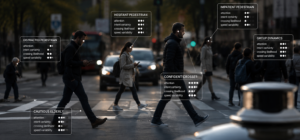
A pedestrian hesitates. A cyclist begins to turn. A vehicle drifts towards a lane. Changes in movement offer clues to what may happen next – often before an action is complete.
SpatioTemporal models these patterns over time, helping machines infer intent and respond to changing behaviour.
Compressing space and time into Motion Tokens – a compact vocabulary of movement.
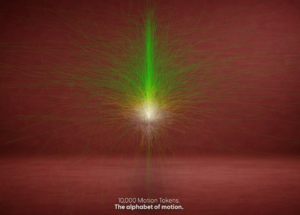
Short, overlapping windows of position and motion become learned Motion Tokens. Our current vocabulary contains 10,000 motion primitives.
The model learns from transitions between these tokens, capturing how movement develops over time and what those changes may imply.
See 10,000 Motion Tokens in our interactive explorer →
See how Motion Intelligence changes robot behaviour.
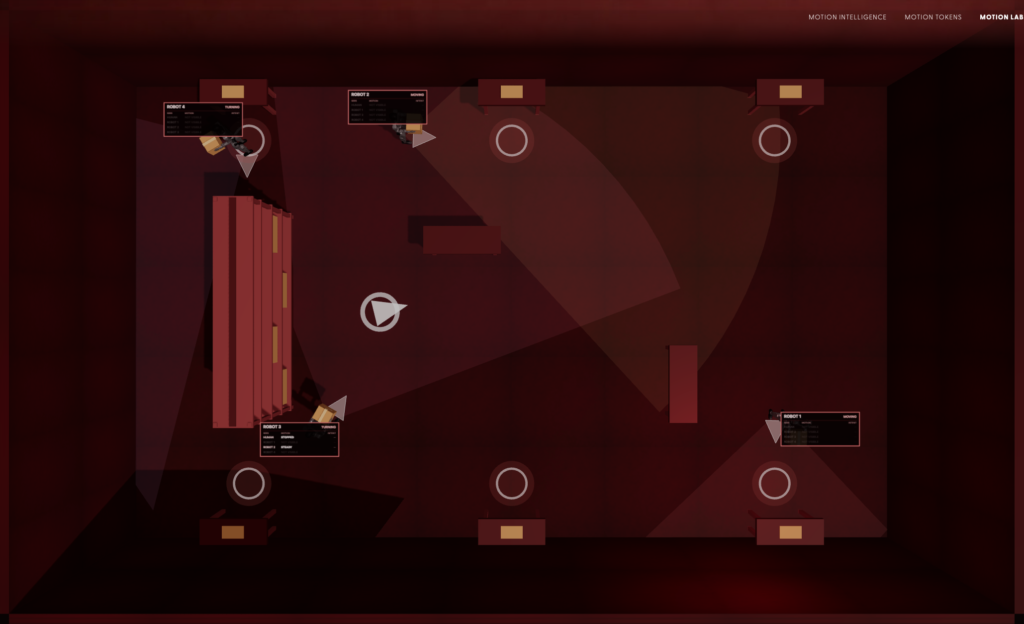
The Motion Lab puts you inside a shared space with autonomous robots.
Walk towards them. Hesitate. Change direction. Step into their path.
Then switch Motion Intelligence on and off and see how their behaviour changes.
The simulation and inference run locally in your browser, using a compact Motion Intelligence model of around 30 MB.
Research is how we test the thesis
From model architecture and simulation to human behaviour and Physical AI systems, our work explores what machines need to understand before they can operate naturally around people.
- Can NVIDIA’s Cosmos 3 Read the Room?
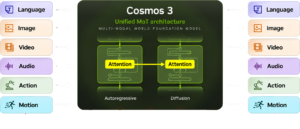 NVIDIA invited SpatioTemporal to put Cosmos 3 through its paces. We tested whether our Motion Intelligence foundation model could help it better understand a moving world. In controlled benchmarks using real motion trajectories, Cosmos identified the actors that mattered with 8× greater accuracy.
 - The Robot Brain Is Splitting by Time
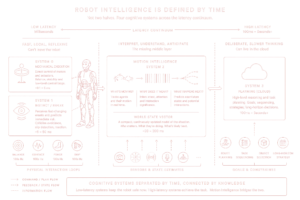 Léo Morillon, who writes about the emerging robotics stack, described a robot brain being divided by latency: “Rent the plan, not the reflex.” The premise is straightforward. Some parts of a robot’s intelligence can move to the cloud. Others physically cannot.
 - THANK YOU FOR YOUR ATTENTION
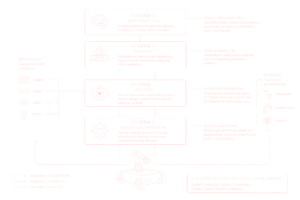 Trust, selective cognition and the reflexive intelligence robots need around humans
24% → 2%
Near-collisions in an NVIDIA Cosmos simulation, comparing an unchanged navigation planner against the same planner augmented with Motion Intelligence.
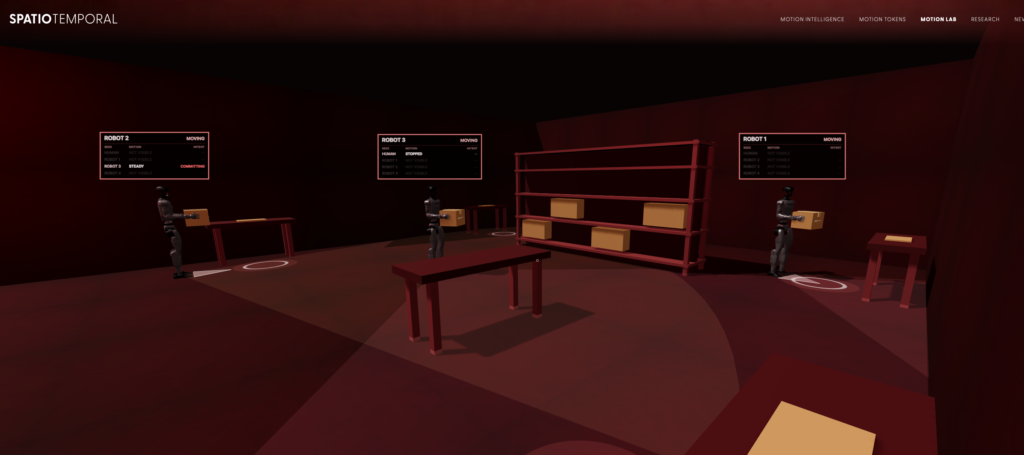
Earlier yielding. Smoother shared-space negotiation. Less planner volatility.
Read how we performed the experiment →
News
- Building the infrastructure for trusted robotics: The Robot Benchmark and The Robot Range
 SpatioTemporal is proud to be a Founding Partner of two new initiatives designed to help solve one of the biggest problems facing robotics and Physical AI: proving what robots can actually do in the real world.
 - SpatioTemporal Named Runner-Up in Propel-AIR 2.0
 SpatioTemporal was named runner-up in Propel-AIR 2.0, Australia’s AI and robotics commercialisation program led by ARM Hub and designed to help Australian technology companies build pathways into international markets.
 - SpatioTemporal featured on SME AI’s ‘ROI from AI’ Podcast
 SpatioTemporal founder Andrew Ballard recently joined Andrew Lai and Amir Nissen from SMEC AI for a conversation about Motion Intelligence, foundation models and a different approach to building AI for the physical world.
Robots that read the room.
Cars that read the road.
SpatioTemporal is building Motion Intelligence for machines operating in the human world.
Explore the technology →
Read the research →
Work with SpatioTemporal →